
I think LotR could have ended much differently if Frodo had just turned to Sam and said, “Hey, look, I realize you hate Gollum and don’t trust him at all, but could you please give him a chance? Genuinely be supportive of him? I don’t know if you’ve noticed, but I am Projecting Heavily on him and my hope and sanity kind of hinges upon believing that he can be redeemed. I thought I was being really obvious about that but maybe not.”
“That’s all very well to say, Mr Frodo, but you and Peter Jackson were both asleep the one time I tried to bond with him over cookery and it didn’t end too well regardless, and also my own stability is pretty heavily dependent on my fixed intention to protect you, so I don’t have a lot of cope left over for him, if you understand me.”
“Christ, precious! Are WE the most psychologically stable ones on this trip?!”
*gandalf, six thousand miles away chillin on a beach, suddenly slaps himself in the forehead* EAGLES
Posts tagged lotr
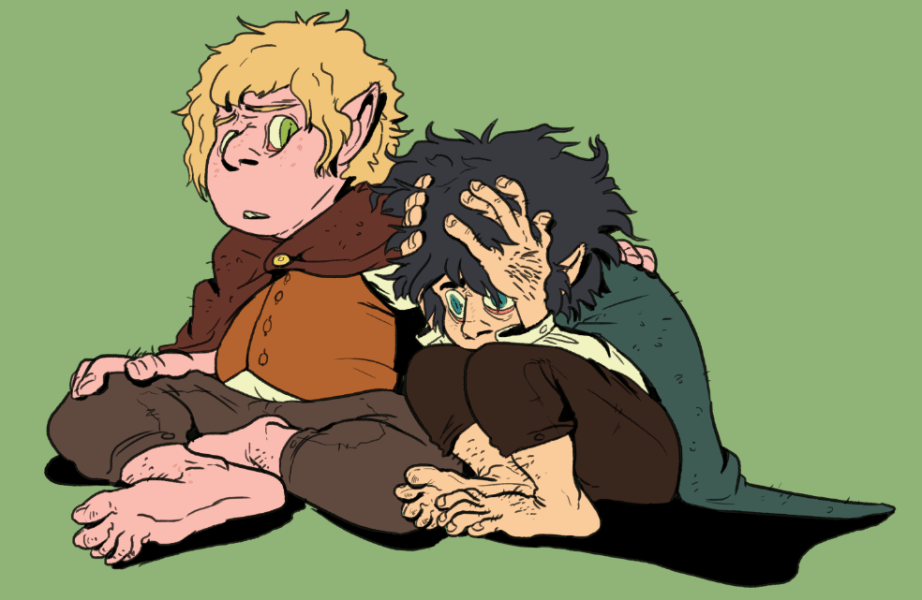

im 2/3s of the way done watching “9 Hours and 18 Minutes of Elijah Wood Looking Like Hes Going To Cry: The Trilogy”
6) Tolkien’s hero was average, and needed help, and failed.
This is the place where most fantasy authors, who love to simultaneously call themselves Tolkien’s heirs and blame him for a lot of what’s wrong with modern fantasy, err the worst. It’s hard to look at Frodo and see him as someone extra-special. The hints in the books that a higher power did choose him are so quiet as to be unnoticeable. And he wouldn’t have made it as far as he did without his companions. And he doesn’t keep from falling into temptation.
A lot of modern fantasy heroes are completely opposite from this. They start out extraordinary, and they stay that way. Other characters are there to train them, or be shallow antagonists and love interests and worshippers, not actually help them. And they don’t fail. (Damn it, I want to see more corrupted fantasy heroes.) It’s not fair to blame Tolkien for the disease that fantasy writers have inflicted on themselves. […]
Fantasy could use more ordinary people who are afraid and don’t know what the hell they’re doing, but volunteer for the Quest anyway.
It’s misinterpretation of Tolkien that’s the problem, not Tolkien himself.
(via mithtransdir)
The whole point of The Lord Of The Rings… like, the WHOLE POINT… is that it is ultimately the hobbits who save the world. The small, vulnerable, ordinary people who aren’t great warriors or heroes.
Specifically, Sam. Sam saves the world. All of it. The ultimate success of the great quest is 100% due to a fat little gardener who likes to cook and never wanted to go on an adventure but who did it because he wasn’t going to let his beloved Frodo go off alone. Frodo is the only one truly able to handle the ring long enough to get it into Mordor – and it nearly kills him and permanently emotionally damages him – but Sam is the one who takes care of Frodo that whole time. Who makes him eat. Who finds him water. Who watches over him while he sleeps.
Sam is the one who fights off Shelob.
Sam is the one who takes the Ring when he thinks Frodo is dead.
Sam is the one who strolls into Orc Central and saves Frodo by sheer determination and killing any orc who crosses him. (SAM THE GARDENER GOES AND KILLS AN ACTUAL ORC TO GET FRODO SOME CLOTHES LET’S JUST THINK ABOUT THAT). And then Sam just takes off the Ring and gives it back which is supposed to be freaking impossible and he barely even hesitates.
Sam literally carries Frodo on the last leg of the journey. On his back. He’s half-starved, dying slowly of dehydration, but he carries Frodo up the goddamn mountain and Gollum may get credit for accidentally destroying the ring but Sam was the one who got them all there.
Sam saved the world.
And let’s not forget Pippin and Merry, who get damselled out of the story (the orcs have carried them off! We must make a Heroic Run To Save Them!) and then rescue themselves, recruit the Terrifying Ancient Powers through being genuinely nice and sincere, and overthrow Saruman before the ‘real’ heroes even get there.
Let’s not forget Pippin single-handedly saving what’s left of Gondor – and Faramir – by understanding that there is a time for obeying orders and a time for realizing that the boss is bugfuck nuts and we need to get help right now.
Let’s not forget Merry sticking his sword into the terrifying, profoundly evil horror that has chased him all over his world because his friend is fighting it and he’s gonna help, dammit and that’s how the most powerful Ringwraith goes down to a suicidally depressed woman and a scared little hobbit.
Everything the others do, the kings and princes and great heroes and all? They buy time. They distract the bad guys. They keep the armies occupied. That is what kings and great leaders are for – they do the big picture stuff.
But it is ultimately the hobbits who bring down every villain. Every one. And I believe that that is 100% on purpose. Tolkien was a soldier in WWI. His son fought in WWII. (And a lot of The Lord Of The Rings was written in letters to him while he did it.)
And hey, look, The Lord Of The Rings is about ordinary people – farmers, scholars, and so on – who get pulled into a war not of their making but who have to fight not only because their own home is in danger but so is everyone’s. And they’re small and scared but they do the best they can for as long as they can and that is what actually saves the world. Not great heroes and pre-destined kings. Ordinary people, doing extraordinary things because they want the world to be safe for ordinary people, the ones they know and the ones they don’t.
Ordinary people matter. They can save the world without being great heroes or kings or whatever. And that is really important and I get so upset when people miss that because Aragorn and Legolas and Gimli and Gandalf and all the others are great characters and all but they are ultimately a hobbit delivery system.
It is ordinary people doing their best who really change the world, and continue doing so after the war is over because they have to go home and rebuild and they do.
(via hearthburn)
God yes.
(via pluckyyoungdonna)
Just last night my dad, a Vietnam vet, said that people ask him what war is like and he always says “It’s just being scared 24 hours a day every single day.” And he said their reaction is always confusion because in their minds soldiers are brave heroes.
The truth is they are most often just scared kids moved around a map like pawns on a chessboard.
(via geekyjessica)
Frodo Didn’t Fail
The climactic scene of The Lord of the Rings, when Frodo and Sam reach the Cracks of Doom, is one of my favorite scenes in all of literature. So I was very interested a little while back when noted Tolkien scholar Stephen Colbert laid out a neat little analysis of the scene. Frodo seems to fail at his appointed task – rather than throwing the ring into the fire, he claims it for himself, and the ring is only destroyed by the coincidental intervention of Gollum. Colbert then notes that Gandalf should have known that Frodo would fail. Back in the second chapter, Frodo demonstrated to Gandalf his inability to throw the ring into the much cooler fires of his own hearth, after having only possessed the ring for a few hours. Therefore, one may assume, Gandalf must have intended for one of the other members of the Fellowship to intervene and ensure the ring’s destruction.
Colbert’s analysis is clever, in the same way that the theory that Gandalf had intended all along to use the eagles to reach Mordor is clever. In its cleverness, though, I think such analyses risk treating LotR as a D&D campaign and thus losing sight of the real literary themes of the story.
One of Tolkien’s key themes is the Augustinian view of evil. Most genre fiction takes a decidedly Manichean view of evil – a view that holds that evil and good are two great opposing forces in the world, like the light and dark sides of The Force. In a Manichean view, good must triumph by opposing evil, either to eradicate it or to restore a balance to the universe.
Manichean views of evil lead to a very common type of climax to stories: the contest of wills. Our hero confronts the villain, and through superior courage, grit, love, or what-have-you, they overcome the villain and their evil power. It’s Harry going wand-to-wand with Voldemort, Thomas Covenant laughing at Lord Foul, Meg breaking IT’s hold over Charles Wallace, Luke facing down Vader and Vader facing down the Emperor.
Any other writer could have given us a very typical Manichean Cracks of Doom scene. Frodo approaches the fire, and the ring’s temptation overtakes him. He puts the ring on and begins to claim it. But a tiny voice somewhere deep inside him insists that this is wrong. Sam cries out, and thinking about Sam’s love and devotion rekindles a spark in Frodo. His Hobbitish desire for food and good cheer wells up, and he tears the ring off and throws it into the fire. A dramatic ending and a nice echo of the moral of The Hobbit.
But that’s not what happens. Frodo’s goodness – even the innocent goodness of a little old Hobbit – can’t go toe-to-toe with Sauron’s evil. Indeed, Isildur proved it. He defeated Sauron by opposing him with the force of good, and defeated him. But Isildur couldn’t destroy the ring, and within the year it had destroyed him.
Tolkien holds instead to an Augustinian view of evil. Evil, according to St. Augustine, is not a force of its own, but rather is the absence or corruption of good. We see this most explicitly in the idea that Morgoth and Sauron can’t create anything of their own, but only corrupt and warp what has been created by others. We also see it when Gandalf and Galadriel describe what would happen if they took the ring – it would warp their own desire to do good until they became evil.
An Augustinian climax can’t involve a contest of wills between good and evil. In an Augustinian world, evil can only exist by leeching off of good. So evil must be given an opportunity to destroy itself, much like the self-defeating band of thieves described by Plato (on whose philosophy Augustine drew heavily). Good wins by renouncing evil, not by overcoming it.
And that’s exactly what happens at the Cracks of Doom. The ring isn’t destroyed because Frodo’s force of good overcame the ring’s evil. Nor is Gollum’s intervention a coincidence or deus ex machina (like the series of disarmings that happened to make Harry the master of the Elder Wand). Rather, the ring’s evil collapsed in on itself by drawing Gollum. The very corruption of Gollum that enabled the ring to escape the river drove him to wrestle desperately with Frodo for it and ultimately fall to his doom, ring in hand.
An Augustinian view of evil has definite moral implications, which are also shown throughout The Lord of the Rings. A Manichean world is a consequentialist world. To defeat the forces of evil, we need to think strategically. Sometimes we may even need to indulge in a little short-term evil in order to be able to achieve the greater good. But an Augustinian world can’t allow that kind of pragmatic approach. In an Augustinian world, any compromise with evil can only strengthen it, giving it an infusion of good that delays its self-destruction. An Augustinian world demands a deontological ethic, doing the right thing regardless of the outcome.
Again and again in The Lord of the Rings, we see that strategically pursuing the greater good fails, while remaining true to moral principles succeeds even when it looked foolish. On the cautionary side, we have Saruman and Denethor. Though they may point to the palantir as an excuse, they each ultimately made a thoroughly reasonable choice in the face of Sauron’s overwhelming advantage – to ally with him while playing the long game, or to give in to despair. Our heroes, on the other hand, repeatedly make foolish decisions based on hope. Aragorn is a good example – he decides to pursue Merry and Pippin because he owes them protection even though Frodo is the one who holds the fate of the world in his hands. Later, he decides to make a suicide attack on the Morannon rather than hunkering down in Minas Tirith, in the hopes of Frodo’s quest succeeding.
But the most important instance of doing the right thing despite the consequences comes from Frodo himself: he refuses to kill Gollum. Killing Gollum would have been an eminently reasonable idea – he’s a slinker and a stinker, and we know that he never redeemed himself or turned over a new leaf. Indeed, his main accomplishments were to lead Frodo and Sam into a death trap, then to try to kill them with his own hands at the Cracks of Doom. Both Sam and Faramir were right when they said that killing Gollum would have been a good idea!
But Frodo showed Gollum pity and spared his life because it was the right thing to do. And just like Gandalf could see Frodo’s unwillingness to destroy the ring back in Bag End, he also addressed this very issue. He instructed Frodo:
Frodo: It’s a pity Bilbo didn’t kill him when he had the chance.
Gandalf: Pity? It was pity that stayed Bilbo’s hand. Many that live deserve death. Some that die deserve life. Can you give it to them, Frodo? Do not be too eager to deal out death in judgment. Even the very wise cannot see all ends. My heart tells me that Gollum has some part to play yet, for good or ill before this is over. The pity of Bilbo may rule the fate of many.
And in the end, that pity was what saved the world. Frodo’s pity made it possible for Gollum to be there at the Cracks of Doom to take the ring. Frodo refused to give in to the small, reasonable evil of killing Gollum, and so he left the great evil of the ring exposed to destroy itself. That was Gandalf’s backup plan, not Aragorn’s strength to take the ring and destroy it. And so Frodo didn’t really fail. He succeeded at his quest back when he saved Gollum’s life, when he did the right thing even though it seemed foolish.
 A Beautiful Monster