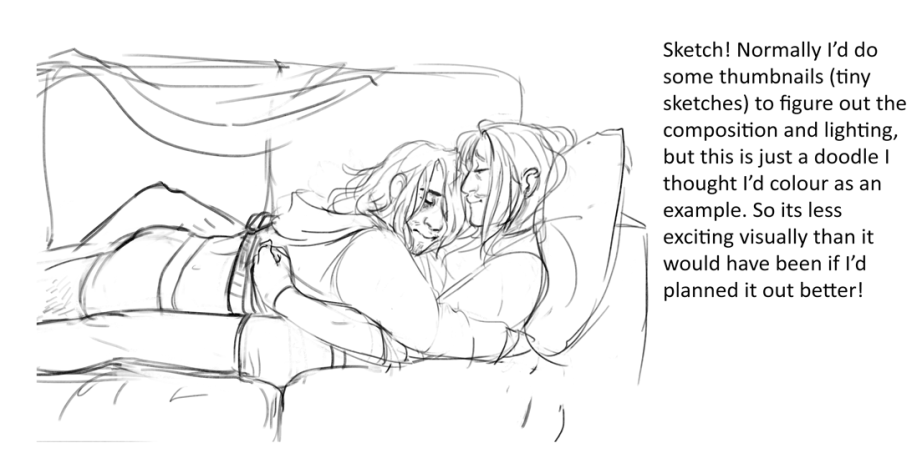
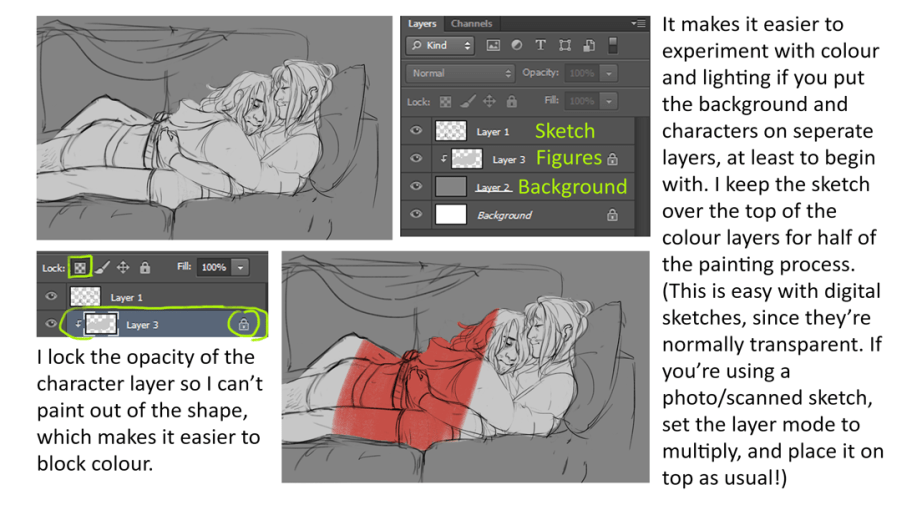
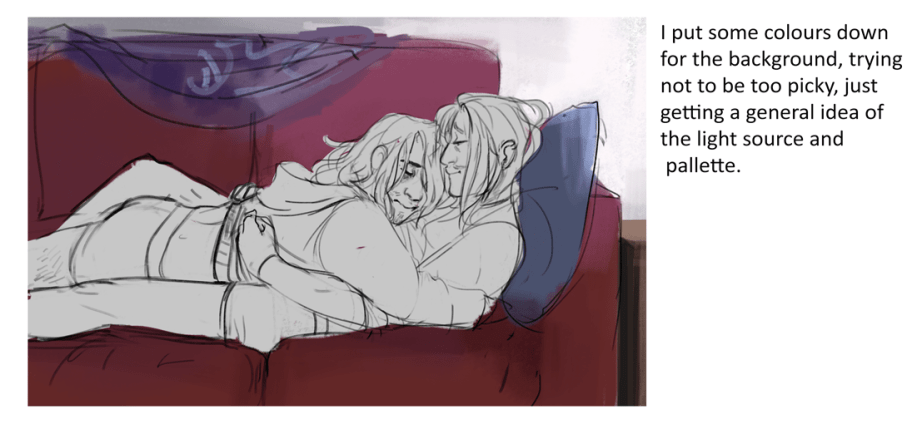
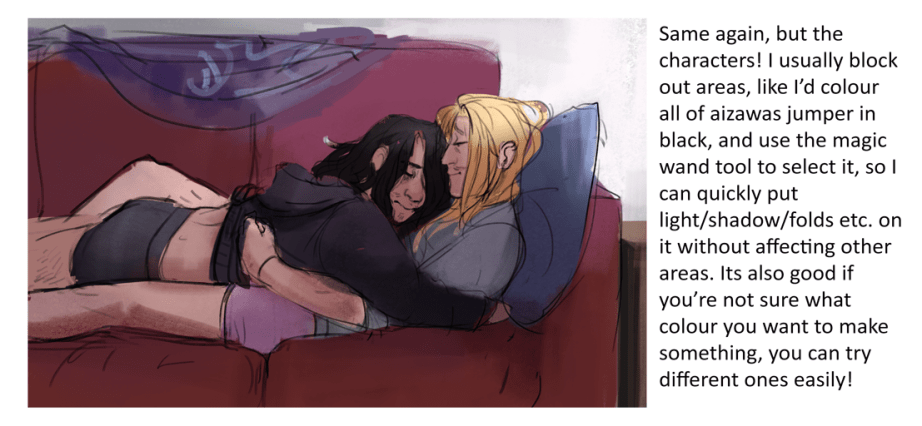
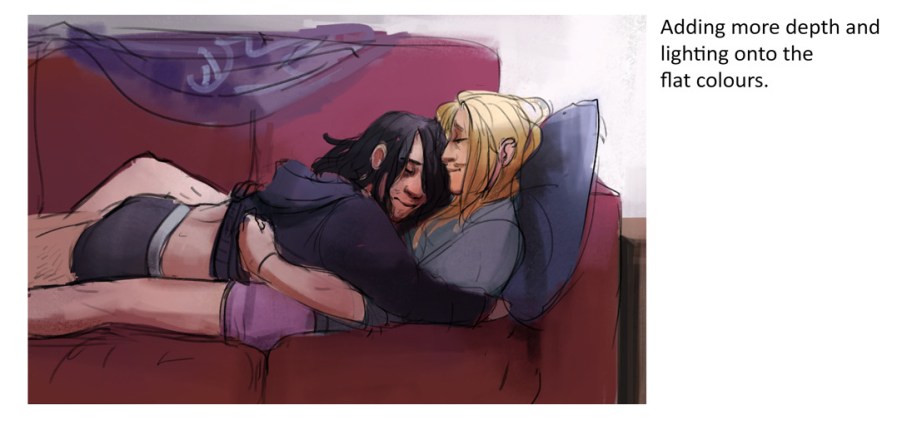
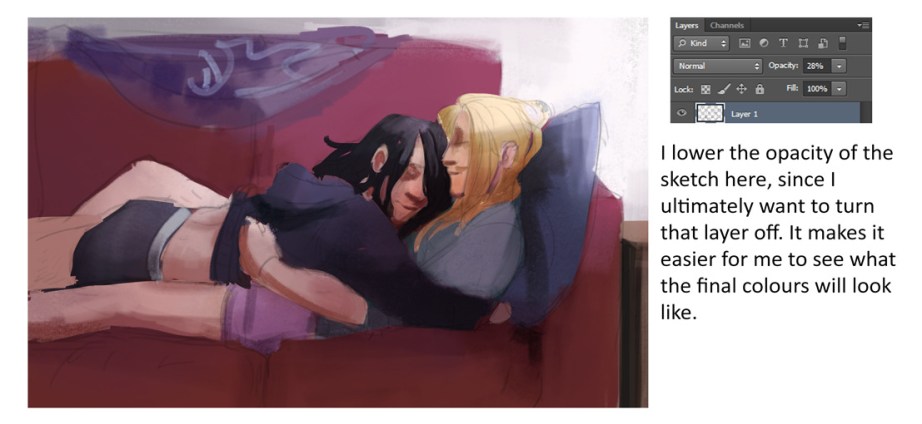
A couple of people have asked about my process, and its changed quite a bit since I started the 30 day challenge, so I figured I’d make a new step by step.
I used to merge the sketch and colour layers, and paint on top, but it just meant I was going around the painting trying to cover up my nasty sketch lines, so getting rid of them to begin with is a lot faster. I also use a lot more lasso and magic wand tools to make the process faster, and image adjustments are your friends. [under image- adjustments] I especially use the levels, saturation, and colour balance. Also! The overlay layer mode is magic if you use it reasonably. Try a light colour over a painting, it’s a fast way to establish lighting. The colour layer mode is good for harmonising colours in your painting, if you set it to a low opacity after filling it with a block colour or gradient.
I pretty much work in one or two layers, I make a new one to try something out, like a lighting idea, and if I like it I merge it down. I normally have a character and background layer, with extras for things like windows or glasses, or complex things like fences etc.
thank you both for such nice messages, I’m so glad you like my art…!! hopefully I can help at least a little bit!
anon 2) my brush settings can be found here! anon 1) wrinkles can get pretty complex! it depends on the type, weight, thickness, and cut of the fabric, whether the character is in motion, etc; I wish I could get into everything, but it’s a huge subject that I don’t think I could possibly cover…!! but I can at least give you some very very basic tips on building up a dress (and the lace underneath!)
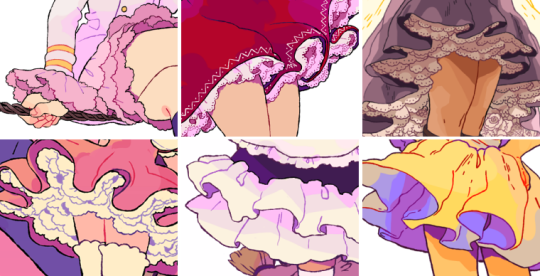
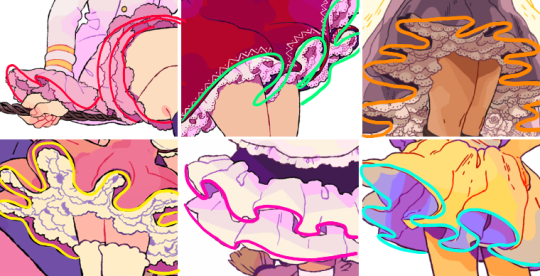
here are some examples of dresses I’ve drawn recently. they might seem complex, but when broken down to their most basic form, they’re actually very simple shapes that follow very similar rules!
are you seeing any patterns between them? while they do differ a bit, they’re by and large made from the same long line that curves into itself and back out. learning where this line goes and how it changes under different circumstances is learned largely through practice and intuition, but there are some steps you can take to begin building a foundation to work from! (or at least to sort of break down the process!)
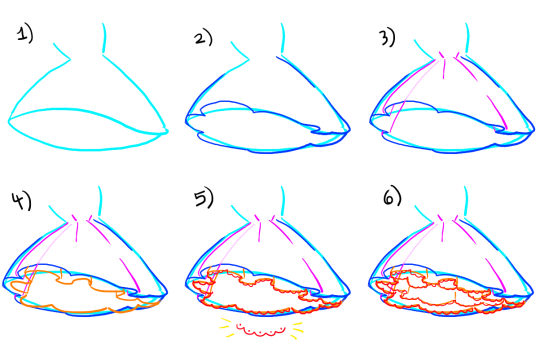
determine the shape/angle of the dress itself.in this example, I’m using a big poofy dress shown from slightly below!
use this as a guide when adding that curving line from before. think of how the fabric folds, and keep in mind that the direction of the curve (and how harsh it appears) depends on where it falls on the dress and the angle at which it’s being viewed from. in this example, it’s more pronounced on the edges, and is facing different directions on the left and the right sides.
wherever cloth folds, wrinkles appear! wrinkles will be more abundant where the cloth is more compact; in this case, that’s toward the waistline. on a dress like this, a fold will originate at the waistline and radiate downward; this means that on an uninterrupted fold, the line that you draw should (if you were to continue it all the way, which is not always necessary) reach cleanly back to the waist. I added one translucent line to help illustrate this idea!
want to add a lace layer? it’s the same concept!! add your basic curving line underneath, keeping in mind that the cloth above will likely mirror whatever it’s falling over. (not perfectly, but somewhat!) so try to keep it a little consistent!
details are easy now!! you can add any sort of lace pattern you want by just tracing over that first line! I used a basic scallop shape here
want even more lace? just repeat step four as many times as you want underneath your last layer of lace!
once you get the hang of this part, figuring out more complex stuff gets much easier! I’m not great at explaining things, but hopefully you were able to come away with some kind of new information, haha…!! I’m wishing you both the best with your art!!!
A really great tutorial on skirt ruffles that I wanted to share with all the artists who follow me! 😀
No more melted tomblerones or mising skulls, yyeann!
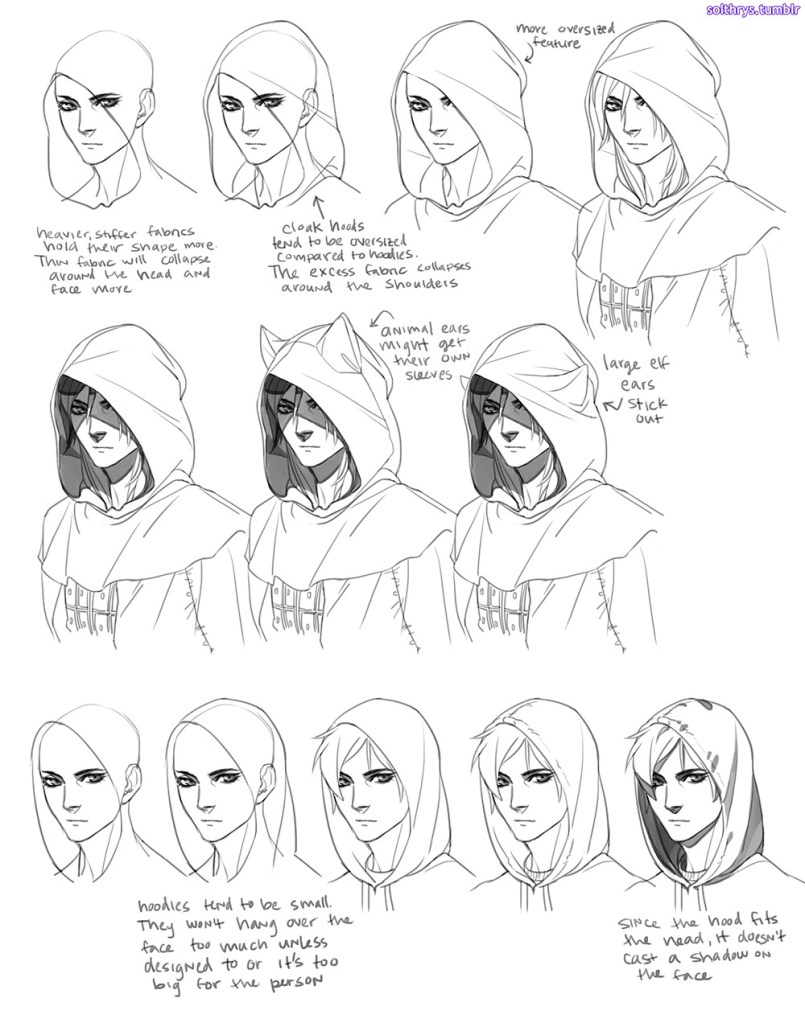
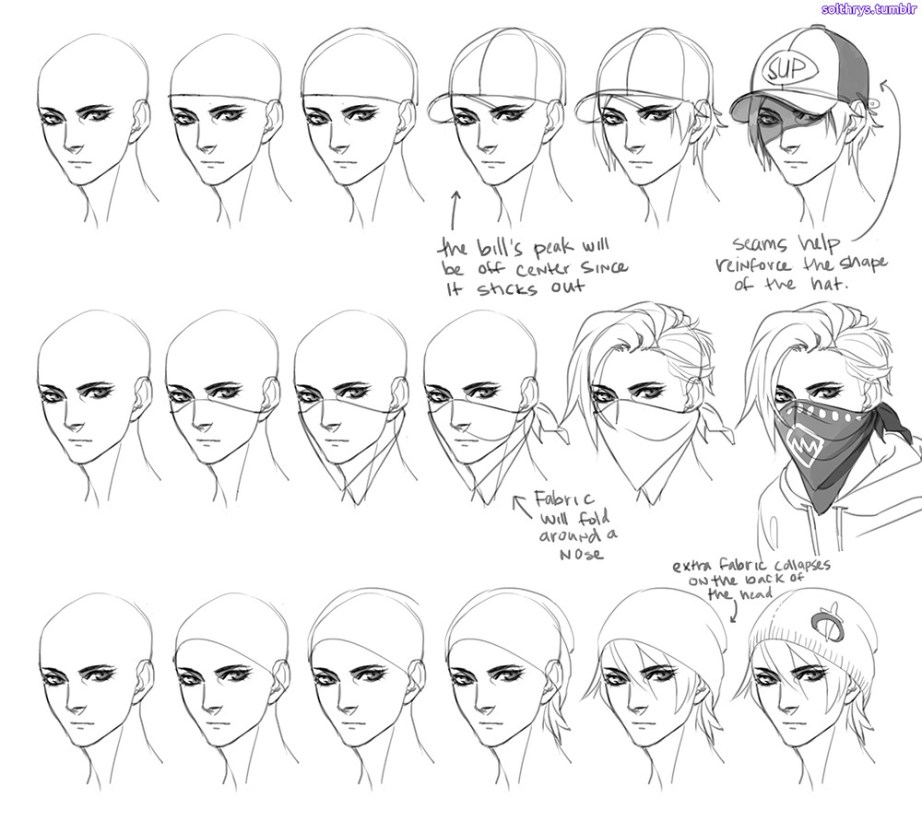
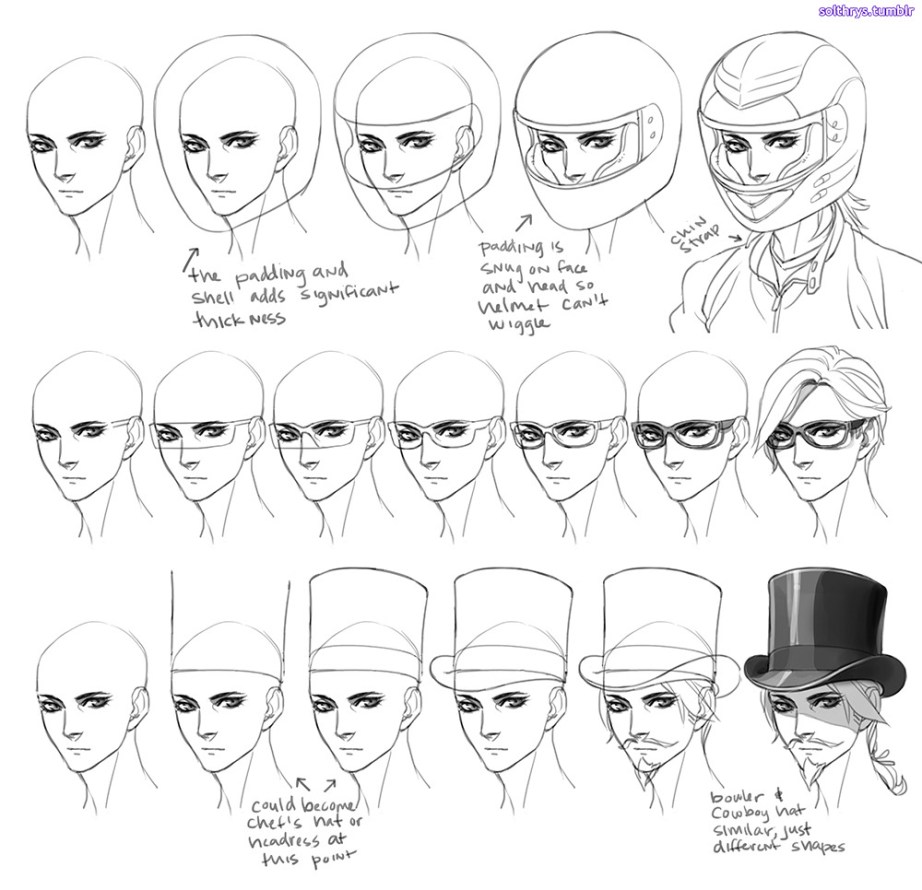
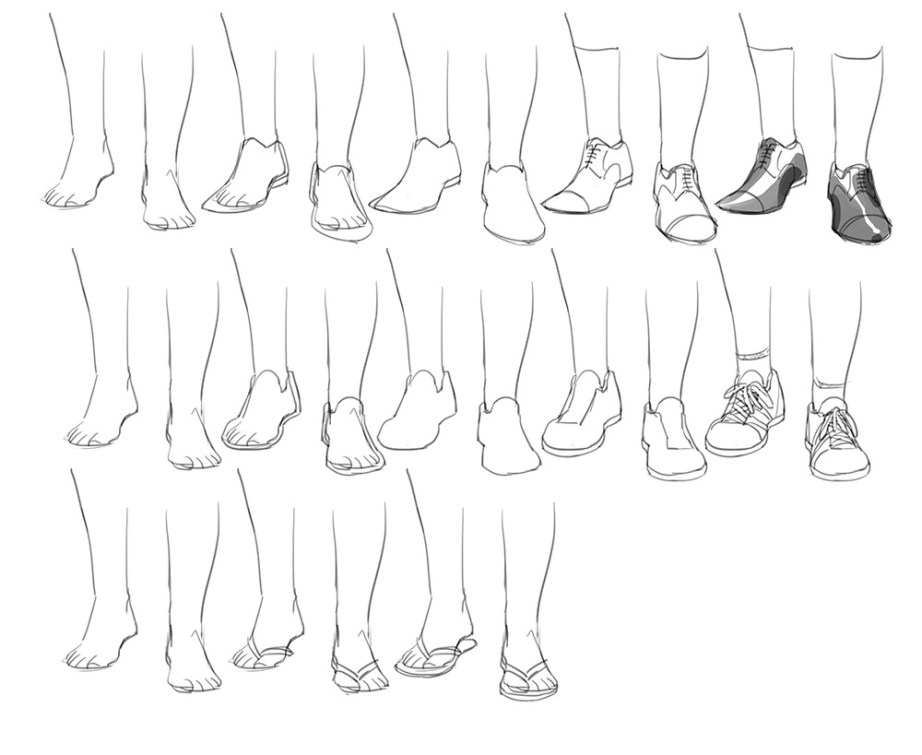
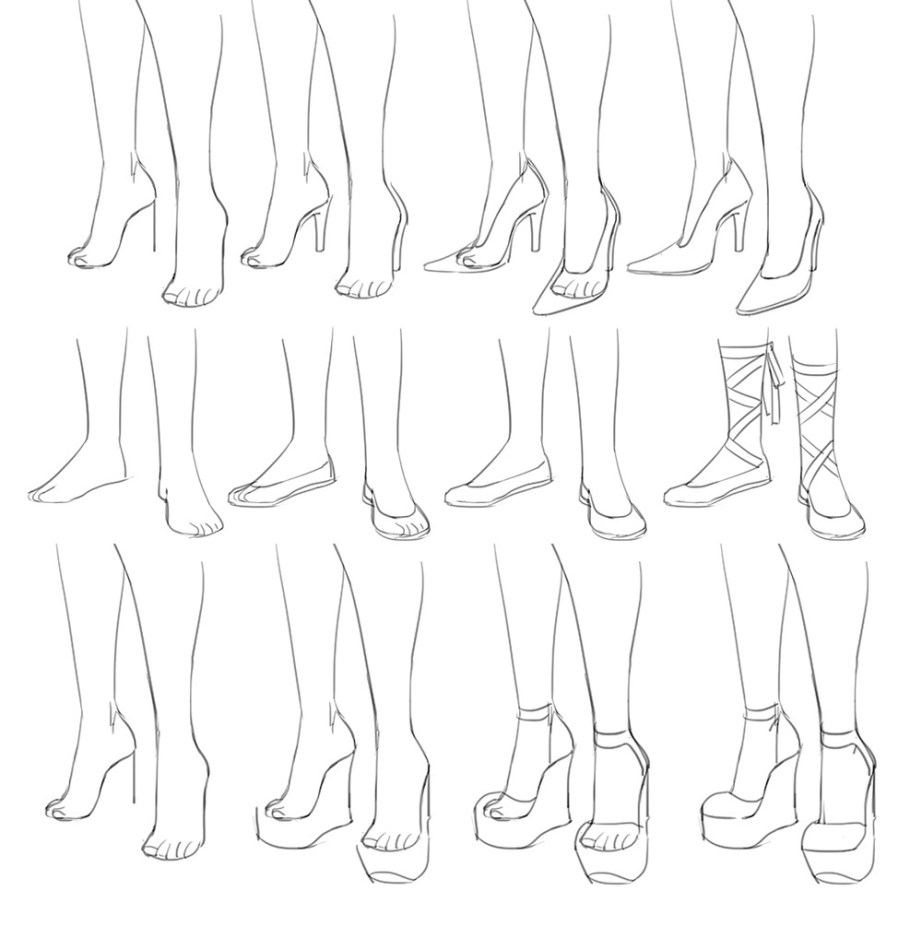
This is my basic process for pretty much everything I draw. The key is understanding the shape of the garment you’re trying to draw and the shape of the body part you’re putting it on.
Drawing the body first forces you to make the shoe, hat, or clothes fit that body. With practice you’ll be able to skip some steps. This method works the same no matter the perspective or pose. It just relies on your knowledge of what a hat looks like from above, or what the bottom of a shoe looks like. When in doubt, just google refs. Don’t necessarily need the exact angle you’re trying to draw. Look at different pics to give you an idea of how it works in 3d.
Shoes are always a bit tricky because feet are a stupid ass shape.
It might help if you think of hats as a cylinder fitted to the person’s head to help you get the perspective right before you push in detail. note: heads aren’t circles. they’re kind of egg shaped if you look at them from the top.
Well thank you and I will try my best to explain how I do my magic
The big secret to poses and stuff is to just keep your hand really really loose and flowy. I kinda pretend the body I’m drawing is made up of water and doesn’t really have any bones-once I figure out the pose, THEN I hammer it down with technical work and fine detail.
There’s also the magical and mystical “line of action”
These guys are really important and are a tremendous help out if the drawing your making looks a little stiff. The line of action is basically one giant sweeping line that creates an arc that your characters body can follow. REALLY good for dynamic poses. Speaking of dynamic poses:
Dynamic poses are better achieved if there is perspective thrown into the mix-an upshot a downshot, any way you can change up how the character is facing the “camera” other than directly placed in front of it. Notice how the line of action is pretty much the same, except its volume changes in each drawing.
I also wanna point out that those weird skeleton model Q-Tip thingies do absolutely fuck all for helping with posing and volume construction.
On the left I used the Q-Tip atrocity and on the right I broke the body into shapes and used the spine as a sort of guide/line of action. The Q-Tip drawing got the girl placed into the sketch (basically just putting a “marker” down for where shes gonna be standing) but thats about it. The shapes method helps figuring out the spacing between body parts, defines the line of action easier, and is far less rigid than the Q-Tip method.
The Q-Tip also doesn’t help with proportioning or perspective so unless you can somehow make it work for you I really don’t recommend using that.
As for expressions I kinda already did a post on that HERE but I’ll explain it a little bit more in this post.
Emotions can be simplified into 3 building blocks (I’m not counting fear here as thats technically a primal response to danger and not really an emotion.) Combining said bulding blocks together to create more complex emotions is what gives us good acting in a character. Just keeping them among the 3 blocks is what keeps them stale.
Not only does combining emotions spice up the character acting, but distorting facial features is a big help too-like the shrinking and expanding of the iris for example.
Lastly when creating an expression you wanna use the WHOLE FACE not just the eyes. Involving the nose, the cheeks and the mouth and eyes all at once is what really defines what the character is feeling without the use of words.
I’m really bad at getting my thoughts all together in a coherent fashion so I hope I managed to explain it all okay. What really REALLY REALLY helps is studying people in movies or even watching people in public interacting with each other. Studying from life is the best thing you can do-ESPECIALLY when it comes to poses and anatomy.








 A Beautiful Monster